Rechercher dans ce blog

Tuesday, December 27, 2022

Rs 10,000-12,000 crore PLI sops soon for hi-tech IT, mobile components - Economic Times

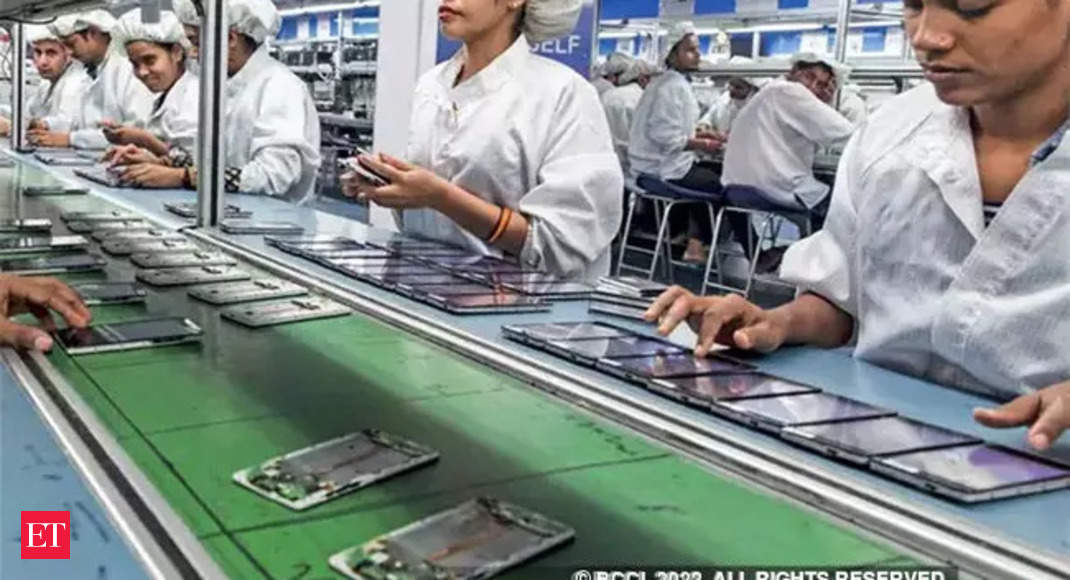
The Ministry of Electronics and IT (MeitY) is working on an incentive scheme, with a likely financial outlay of around Rs 10,000 crore to Rs 12,000 crore, to promote domestic manufacturing of high-end components that could go into products such as smartphones, servers and personal computers.

The objective of the components incentive scheme is to develop a complete ecosystem of electronics manufacturing in India, officials aware of the details of the plan told ET. The move may further help attract global majors such as Apple to deepen local production, say experts.

“The scheme may offer incentives on production of components as well as capital support for setting up production facilities. The final contours of the scheme are still to be finalised, but we are aiming to come out (with the policy) by next financial year (starting April 1),” an official said on the condition of anonymity.


The government has already indicated that it would be open to joint venture (JV) partnerships with the Chinese firms for high-tech components, which will enable the likes of Apple to further expand manufacturing in India. The incentive scheme for components will aid companies located in geographies such as Taiwan, Korea and Japan to relocate or set up new units here.

The components incentive scheme becomes even more important, primarily because an existing scheme for the promotion of manufacturing of electronic components and semiconductors (SPECS) with an outlay of Rs 3,285 crore is coming to end by March 2023. SPECS was launched alongside the Rs41,000 crore production-linked incentive (PLI) scheme for smartphones in April 2020, for a period of three years.

SPECS was aimed at promoting manufacturing of high-value-added items such as electronics components and subassemblies such as camera modules, vibrator motors, display assemblies and touch panels. The scheme also provides incentives for the manufacturing of capital goods of the scheme-notified electronic items.

The plan has led to investments of around Rs 12,000 crore so far, as per details shared with ET by the Indian Cellular and Electronics Association (ICEA). The industry has been demanding that SPECS be extended for a further period of five years with a budgetary outlay of at least Rs 10,000 crore to support component manufacturing. According to the ICEA, given the massive dependency on China for finished products, especially IT hardware, it is impossible to create a relocation pathway to deepen global value chains in India without tier-2 and -3 manufacturers for finished products, subassemblies and components from India’s neighbour.

The government is targeting electronics manufacturing worth $300 billion by 2026, of which $18 billion could be for components. The industry says it needs continuous support from the government because the disability of the Indian electronics system design and manufacturing sector as compared to other countries like Vietnam is still 10-14% on account of cost of finance, logistics and power, etc.

Officials said the government is aware that a successful ecosystem for electronics manufacturing can only be developed when the components are produced locally.

The intent of the government can be gauged from the fact that even the existing PLI schemes, like the one for IT hardware manufacturing, have a localisation schedule. To make it lucrative for component making firms, the government is open to giving selective approvals to Chinese firms also, if they are coming in with a joint venture with any Indian company.

Apart from China, the government wants to encourage joint ventures with firms from Taiwan, Japan, South Korea and Europe for high-tech electronics manufacturing.

The Centre, along with the industry, will soon start an exercise to identify potential Indian companies that can enter into electronics manufacturing through such ventures.

Adblock test (Why?)


Rs 10,000-12,000 crore PLI sops soon for hi-tech IT, mobile components - Economic Times
Read More

Monday, December 26, 2022

Adani effect propels India to become the best-performing stock market in the world in 2022 | Mint - Mint

India is set to rank among this year’s best-performing major stock markets globally, overcoming concerns about higher interest rates and an economic slowdown that has mired peers.

The S&P BSE Sensex Index is up 3% so far in 2022, the biggest gain in the world after measures in Singapore and Indonesia. A solid run of earnings buoyed key Indian benchmarks to record levels, making the market larger than the UK. Meanwhile, the MSCI All Country World Index has fallen 20%. 

This year’s winners include shares linked to billionaire Gautam Adani and banks boosted by a sharp recovery in credit demand. Some of the biggest losers were shares of technology firms that languished following their public debuts and software outsourcing providers that faced concerns of a potential slump in overseas demand. 

The outlook, however, is murkier. The market is seen to lose momentum next year amid elevated valuations, with Goldman Sachs Group Inc. calling an underperformance versus China and South Korea.

Slowing global growth may weigh on the country’s economy in the near term even as its “structural promise" remains a significant long-term attraction, JPMorgan analyst Sanjay Mookim wrote in a note this month. 

Here’s a look at some of the most significant stock moves of 2022:

Adani Firms

Adani’s ports-to-power conglomerate saw at least two of seven listed companies more than double in value this year, led by Adani Power Ltd. as it benefited from a jump in demand for electricity. Flagship Adani Enterprises Ltd. has surged 113% after it became the second group firm to join the NSE Nifty 50 Index. The share price of Adani Wilmar Ltd., the group’s joint venture consumer food business, could gain another 24% from current levels, according to the 12-month consensus price target of analysts. Investors have sold off the group’s stocks of late amid steep valuations.

Bank Recovery

The S&P BSE Bankex has surged 18% this year on the sector’s successful resolution of sour debt, the creation of a bad bank to offload troubled loans and a sharp recovery in credit demand. Uday Kotak, the billionaire managing director of Kotak Mahindra Bank Ltd., called the rebound in banks a “Cinderella" moment. Still, a worsening gap between deposit and credit growth is something to watch out for, according to Macquarie Capital analyst Suresh Ganapathy. State Bank of India, the nation’s largest lender, is up 25% this year and could gain by a similar magnitude over the next 12 months, analysts estimate. 

IPO Letdown 

Lingering disappointment following big initial public offerings sent fintech firm Paytm and online insurance marketplace Policybazaar down more than 50% this year after their trading debuts toward the end of 2021. Other decliners include delivery startup Zomato, the owner of beauty e-retailer Nykaa and logistics firm Delhivery. Life Insurance Corp. of India, which surpassed Paytm to become India’s biggest IPO, has lost more than a quarter of its value since May. 

Software Slump   

Outsourcing providers were among the worst performers amid concerns over a possible recession in the US and Europe. Major firms — including Infosys Ltd. and Tata Consultancy Services Ltd. — slid, pushing the sectoral gauge toward its worst year since 2008. Big information technology services companies are bracing for a “longer winter ahead," said JM Financial Institutional Securities analyst Abhishek Kumar.

Cheaper Generics 

Drug exporters such as Aurobindo Pharma Ltd. and Divi’s Laboratories Ltd. also took a hit as generic drug prices plunged in the US. Sampath Reddy, the chief investment officer at Bajaj Allianz Life Insurance Co., said drugmakers may focus on profitable complex generics in response to lower prices abroad. 

This story has been published from a wire agency feed without modifications to the text. Only the headline has been changed.

Know your inner investor Do you have the nerves of steel or do you get insomniac over your investments? Let’s define your investment approach.

Take the test
Catch all the Business News, Market News, Breaking News Events and Latest News Updates on Live Mint. Download The Mint News App to get Daily Market Updates.
More Less

Adblock test (Why?)


Adani effect propels India to become the best-performing stock market in the world in 2022 | Mint - Mint
Read More

Sunday, December 25, 2022

SGX Nifty up 20 points; here's what changed for market while you were sleeping - Economic Times

Domestic equities are likely to take cues from the global developments, particularly on the COVID situation in China.
In just 20 days after the zero COVID policy was ended by China, the country has seen a whopping 250 million people being affected by the pandemic.

Participation of foreign investors is likely to be lower amid year-end holidays. But any further negative news around Covid could trigger further outflows from FIIs. Options of Nifty 50 indicate a broad trading range of 17000-18000 points for the index this week.

Here's breaking down the pre-market actions:

STATE OF THE MARKETS

SGX Nifty signals a positive start

Nifty futures on the Singapore Exchange traded 22 points, or 0.12 per cent, higher at 17,886, signaling that Dalal Street was headed for a positive start on Monday.
  • Tech View: Nifty 50 has slipped below the 200-DEMA and formed a bearish candle on the daily scale. If it remains below 17950 level, a further fall towards 17500-17650 levels could be seen. In case of a recovery, the index is likely to face hurdles at 17950 and 18081 levels.
  • India VIX: The ‘fear gauge’ ended 6.4% down at 16.16 points on Friday, as the overall sentiment has turned nervous amid rising COVID cases in China.

US stocks rise
The S&P 500 closed higher on Friday, in a light trading day ahead of a long weekend, as investors assessed inflation data against rate hike and recession fears while energy shares jumped on higher oil prices.
  • Dow rises 0.53%
  • S&P up 0.59%;
  • Nasdaq adds 0.21%

Asian shares rise
Asian stocks opened higher on Monday as Japan and mainland China took center stage for traders, with most other Asia-Pacific markets closed for holidays.
  • Japan’s Topix rose 0.3% as of 9:11 a.m. Tokyo time
  • South Korea’s Kospi fell 0.2%
  • The S&P 500 closed 0.6% higher on Friday while the Nasdaq 100 rose 0.3%
  • The Nasdaq Golden Dragon China Index fell 2.9%

FII/DII action
Foreign portfolio investors (FPIs) on Friday net sold shares worth Rs 707 crore, provisional data showed. DIIs net bought shares to the tune of Rs 3,399 crore.

Stocks in F&O ban today

. Securities in the ban period under the F&O segment include companies in which the security has crossed 95% of the market-wide position limit.

Rupee: The local currency ended lower against the dollar on Friday as FPIs moved bets to dollar after domestic equity indices hit a two-month low. The rupee ended at 82.8575 a dollar compared to 82.7625 a dollar on Thursday.

(Disclaimer: Recommendations, suggestions, views and opinions given by the experts are their own. These do not represent the views of Economic Times)

Adblock test (Why?)


SGX Nifty up 20 points; here's what changed for market while you were sleeping - Economic Times
Read More

Stocks in the news: NDTV, Tata Motors, Suven Pharma, Quess Corp, Siemens - Economic Times

The SGX Nifty 50 December futures is pointing to a slightly positive start for domestic equities on Monday. However, trade is expected to be subdued due to lower participation by foreign investors amid year-end holidays.

Also, the rising COVID cases in China has unnerved investors, who are expected to remain on a sell mode.

But here are a dozen stocks which are expected to see some action in trade today:

NDTV: The founders of the company, Radhika Roy and Prannoy Roy, will transfer 27.26% of their stake in the company to Adani Group-owned RRPR Holding. Consequently, Adani Group will hold 64.71% stake in the news broadcaster.

Tata Motors: Subsidiary TML CV Mobility Solutions has bagged a contract from the Delhi

to supply, operate and maintain 1,500 electric buses in the city for 12 years.

Suven Pharmaceuticals: Advent International has signed a binding agreement with the promoter to acquire a significant stake in the company. The private equity firm will make an open offer to acquire an additional 26% stake in the drugmaker.


: The company has withdrawn plans to merge its subsidiary , but did not elaborate on what triggered the decision. : The company will sell 8% stake arm Enzene Biosciences to 2 funds for Rs 160 crore. Proceeds from the sale will be used for capacity expansions in India and the US. : The company has bought a minority stake in US-based Kibsi Inc for $1.5 million. The acquisition is to build a partnership in computer vision applications. : The bank has extended the term of managing director and chief executive officer P N Vasudevan by three years. : The company has bagged a 100-MW wind power project from Solar Energy Corporation of India. : The company has received a letter of award from the railways ministry for a 9,000 horsepower electric locomotives project in Gujarat.

PNC Infratech: Has received Rs 3.65 crore towards an arbitral award with respect to a construction project in West Bengal. Given the amount is very less, it is not expected to materially impact the company’s financials.

: The company’s wholly-owned subsidiary Neelkamal Realtors Tower has entered into a 50:50 joint venture with for development of land parcels measuring 19,434 sq meters in Mumbai.

Welspun Corp: Has commissioned a coke oven plant with a capacity of 210,000 tonne per annum in Anjar, Gujarat. This is likely to help supply coke at competitive prices to run the plant efficiently.

Dhani: Has acquired Juventus Estate Limited and Mabon Properties Limited at an enterprise value of Rs 240 crore. The two companies collectively hold 35 acres of land parcels in Gurugram, Haryana. The acquisition will provide new business opportunities in the real estate sector.

Lasa Supergenerics: The merger of Harishree Aromatics Chemicals PVt Ltd with the company has been approved by the National Company Law Tribunal.

Vaxtex Cotfab: Board of the company is expected to meet on Monday to consider bonus issue of shares.

Adblock test (Why?)


Stocks in the news: NDTV, Tata Motors, Suven Pharma, Quess Corp, Siemens - Economic Times
Read More

World economy headed for a recession in 2023: Researcher - Hindustan Times

Published on Dec 26, 2022 07:07 AM IST

The world faces a recession in 2023 higher borrowing costs aimed at tackling inflation cause a number of economies to contract, according to the Centre for Economics and Business Research.

World economy headed for a recession in 2023: Researcher(Representational image)
Bloomberg |

The world faces a recession in 2023 higher borrowing costs aimed at tackling inflation cause a number of economies to contract, according to the Centre for Economics and Business Research.

The global economy surpassed $100 trillion for the first time in 2022 but will stall in 2023 as policy makers continue their fight against soaring prices, the British consultancy said in its annual World Economic League Table.

“It’s likely that the world economy will face recession next year as a result of the rises in interest rates in response to higher inflation,” said Kay Daniel Neufeld, director and head of Forecasting at CEBR.

Also read: ‘5th largest economy, G20 presidency...’: PM Modi defines India in 2022

The report added that, “The battle against inflation is not won yet. We expect central bankers to stick to their guns in 2023 despite the economic costs. The cost of bringing inflation down to more comfortable levels is a poorer growth outlook for a number of years to come.”

The findings are more pessimistic than the latest forecast from the International Monetary Fund. That institution warned in October that more than a third of the world economy will contract and there is a 25% chance of global GDP growing by less than 2% in 2023, which it defines as a global recession.

Even so, by 2037, world gross domestic product will have doubled as developing economies catch up with the richer ones. The shifting balance of power will see the East Asia and Pacific region account for over a third of global output by 2037, while Europe’s share shrinks to less than a fifth.

The CEBR takes its base data from the IMF’s World Economic Outlook and uses an internal model to forecast growth, inflation and exchange rates.

China is now not set to overtake the US as the world’s largest economy until 2036 at the earliest — six years later than expected. That reflects China’s zero Covid policy and rising trade tensions with the west slow, which have slowed its expansion.

CEBR had originally expected the switch in 2028, which it pushed back to 2030 in last year’s league table. It now thinks the cross-over point will not happen until 2036 and may come even later if Beijing tries to take control of Taiwan and faces retaliatory trade sanctions.

“The consequences of economic warfare between China and the West would be several times more severe than what we have seen following Russia’s attack on Ukraine. There would almost certainly be quite a sharp world recession and a resurgence of inflation,” CEBR said.

“But the damage to China would be many times greater and this could well torpedo any attempt to lead the world economy.”

Also read: US economy grew 3.2% in Q3, an upgrade from earlier estimate

It also predicted that:

  • India will become the third $10 trillion economy in 2035 and the world’s third largest by 2032
  • The UK will remain the world’s sixth largest economy, and France seventh, over the next 15 years but Britain is no longer set to grow faster than European peers due to “an absence of growth oriented policies and the lack of a clear vision of its role outside of the European Union.”
  • Emerging economies with natural resources will get a “substantial boost” as fossil fuels play an important part in the switch to renewable energy
  • The global economy is a long way from the $80,000 per capita GDP level at which carbon emissions decouple from growth, which means further policy interventions are needed to hit the target of limiting global warming to just 1.5 degrees above pre-industrial levels.

Adblock test (Why?)


World economy headed for a recession in 2023: Researcher - Hindustan Times
Read More

Dalal Street Week Ahead: 10 key factors that will keep traders busy next week - Moneycontrol

The market further succumbed to the selling pressure and lost 2.5 percent for the week ended December 23, and recorded the biggest weekly loss since June. Weak global cues, fear of recession, anticipation of further policy tightening by the US Federal Reserve, and resurgence of Covid cases across countries weighed on investors.

The equity benchmarks settled in the red for third straight week, falling nearly 6 percent from their fresh record highs scaled on December 1.

The BSE Sensex slipped below the psychologically crucial mark of 60,000. During the week, the 30-share index plunged nearly 1500 points  to close at 59,845. The Nifty50 retreated 462 points to close the week at 17,807. All sectors, barring healthcare, faced severe selling pressure.

The broader markets were also caught in bear trap as the Nifty Midcap 100 index declined nearly 6 percent and Smallcap 100 index dropped more than 8 percent.

Considering the sharp downfall and lack of major global cues due to Christmas & New Year holiday, the market is expected to consolidate in the coming week, with participants focusing on Covid situation. Besides, experts also feel that the upcoming monthly expiry could add to the volatility, experts said.

"The coming week will mark the end of the calendar year and participants will be eyeing core sector data and current account deficit on December 30. Before that, the scheduled derivatives expiry of December month contracts would keep the participants busy," Ajit Mishra, VP - Technical Research at Religare Broking said.

The performance of the global indices amid the rising fear of COVID cases would further add to the volatility, he added.

The last three weeks of the slide have changed the market structure and indications are pointing toward the decline to extend further, the market expert feels.

Here are 10 key factors that will keep traders busy next week:

1) Covid Concerns

Going ahead, the key factor to watch out for would be resurgence of covid cases. A new new Covid variant, in several parts of the world (including China, United States, Japan, South Korea and France), has been making the market participants cautious since the last week.

Reportedly, surge in Covid cases in China, the world's most populated country, is due to new variant of Omicron - BF.7, which is said to be highly transmissible variant with a shorter incubation period. Even India has reported four Covid cases with the new variant - two in Gujarat and two in Odisha.

2) Macroeconomic Data

On December 30, fiscal deficit and infrastructure output numbers for the month of November will be released.

Besides, data pertaining to bank loan & deposit growth for fortnight ended December 16, and foreign exchange reserves for week ended December 23 will also be released in the coming week on Friday.

Further, current account and external debt numbers for the quarter ended September FY23 will also be released on December 30. Country's current account deficit at $23.87 billion in Q1FY23 (which is 2.8 percent of GDP) was highest since Q3FY13, and even trade deficit was more than doubled to $68.6 billion in the same period compared to year-ago period.

3) Global Macroeconomic Data

Here are key global macroeconomic data points to watch out for next week:
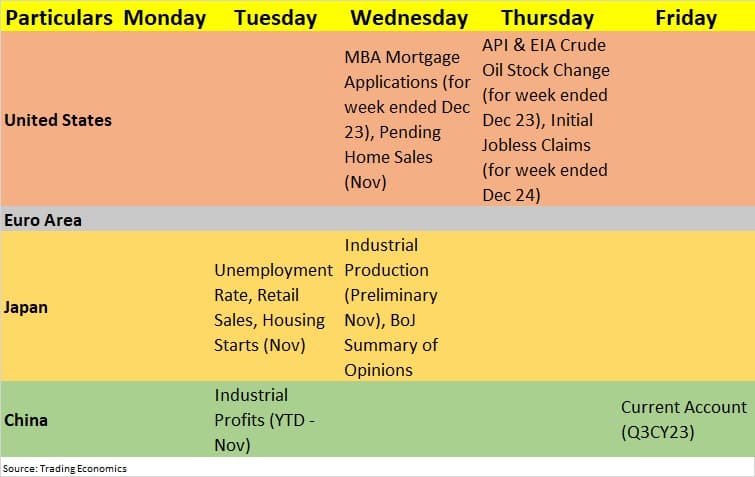
Image1223122022

4) Oil Prices

Oil prices rallied for second consecutive week but overall have been moving in a particular range below $85 a barrel on the Brent crude futures for nearly three weeks now, partly due to weak demand outlook amid slowdown fear.

Last week, the international benchmark Brent crude futures rose by nearly 6 percent to $79 a barrel, after Moscow threatened to cut production in response to price cap on Russian exports by European Union, helping the oil market post gains for second week in a row.

Hence, the market participants will keep an eye on the oil price movement, though experts largely do not expect any kind of sharp spike in coming days.

"The severity of new cases of covid across the world is still not that serious to impose lockdowns, hence we are continuing to see jump in crude oil prices over 5 days. But the slowdown fear due to rate hike have dampened investors’ sentiments. We see limited upside in crude oil prices," Mohammed Imran, Research Analyst at Sharekhan by BNP Paribas said.

5) FII Flow

The flows from foreign institutional investors (FIIs) and foreign portfolio investors (FPIs) remained volatile. However, domestic institutional investors (DIIs) seem confident enough about the country's progress going ahead, and provided great support to the market on the lower side.

FIIs net offloaded shares worth nearly Rs 1,000 crore, as per provisional data, for the week ended December 23, taking the total monthly outflow to nearly Rs 8,500 crore, which have been restricting the market upside.

On the other hand, the recent correction ha been smartly utilised by the DIIs, as they have net bought around Rs 8,500 crore worth shares in the week gone by, taking total monthly inflow at Rs 19,000 crore.

6) IPO

Two public issues will open for subscription, along with two listings in the coming week, keeping the primary market busy in last week of December too.

Initial public offering of Radiant Cash Management Services will enter into second day of bidding on December 26 and the closing date would be December 27.

The retail cash management services provider aims to mop up Rs 388 crore from the maiden issue, at the upper end of a price band of Rs 94-99 per share. The company has reduced its offer size to 2.74 crore shares, from 3.91 crore after mobilising Rs 116.38 crore through the anchor book on December 22, a day before the IPO opening.

Sah Polymers will be the last public issue for the current calendar year, opening for subscription from December 30-January 4. It will announce its IPO price band on coming Monday. The 1.02 crore shares IPO is entirely a fresh issue.

Technology-driven financial services platform KFin Technologies will make its stock exchange debut on December 29, while electronics manufacturing services provider Elin Electronics will hit the bourses on December 30.

7) Technical View

The Nifty50 has formed long bearish candle on the daily charts as well as weekly scale, indicating more weakness in short term. Also it has been making lower highs lower lows for second consecutive week as well as second straight session.

Even the index fell way below its 50 DMA (day moving average - 18,174) as well as 50 DEMA (day exponential moving average - 18,180), and slightly below 100 DMA and DEMA (both around 17,840). Hence, unless and until the index gets back above 50-day SMA as well as EMA, the major upside is unlikely in the market, hence till then there could be more consolidation in the range of 17,800-18,000 levels, with support at 17,641, the low of long bearish candle formed on October 25, experts said.

"Technically, Nifty has broken down multiple support levels effortlessly. However, the relative strength index (RSI) is approaching oversold territory, and if Nifty manages to regain its 100-DMA of 17,840, which coincides with a 50 percent retracement of the previous rally from 16,748 to 18,888, then we can expect a short-covering move in the market," Santosh Meena, Head of Research at Swastika Investmart said.

On the upside, he feels the 18,000–18,100 area will act as a supply zone, and Nifty has to cross its 50-DMA for any meaningful strength. On the downside, "17,640, 17,565, and 17,425 will be the next important support levels."

8) F&O Cues

As we will enter into monthly F&O expiry week, the market may witness volatility. The Option data indicated that 17,500-17,800 area is expected to act as a near term support for the Nifty50, whereas the resistance area could be 18,000-18,200 where we have the maximum Call open interest.

The maximum Put open interest was seen at 17,000 strike, followed by 17,500 strike, & 17,800 strike, with Put writing at 17,800 strike, then 17,600 strike.

On the Call side, we have seen the maximum Call open interest at 18,000 strike, followed by 19,000 & 18,200 strikes, writing at 18,000 strike, then 18,100 strike and 18,200 strike.

"For the coming monthly settlement, once again the Call options open interest in the Nifty is significantly higher compared to Put bases. However, the Nifty is trading below its Put base of 18,000. Despite the Nifty closing well below 18,000, there was no closures in 18,000 strike Puts, which keeps hopes intact of some bounce," ICICI Direct said.

9) India VIX

Volatility increases sharply in past few days, making the bears more comfortable and giving discomfort for bulls. India VIX, the fear index surged by 41 percent from 11.43 level seen on December 13, to 16.16 level on December 23, while during the passing week, it jumped nearly 15 percent. Hence, further northward journey in VIX could put more pressure on the market, experts said.

"Volatility across the globe rose sharply as a new strain of the Covid variant is spreading. India VIX also moved towards 16 percent, which is likely to keep traders on their toes coupled with rollover activity due to December settlement," ICICI Direct said.

10) Corporate Action

Here are key corporate actions taking place in coming week:
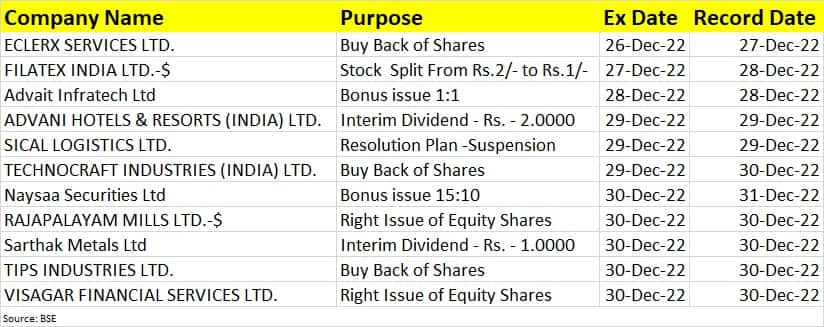
Image1123122022

Disclaimer: The views and investment tips expressed by investment experts on Moneycontrol.com are their own and not those of the website or its management. Moneycontrol.com advises users to check with certified experts before taking any investment decisions.

Adblock test (Why?)


Dalal Street Week Ahead: 10 key factors that will keep traders busy next week - Moneycontrol
Read More
Saturday, December 24, 2022

Elon Musk warns against margin debt on risk of market ‘mass panic’ - Economic Times

Billionaire Elon Musk is warning against something he himself has done — borrowing against the value of securities one owns — because of the risk of “mass panic” in the stock market.
“I would really advise people not to have margin debt in a volatile stock market and you know, from a cash standpoint, keep powder dry,” Musk said in the All-In podcast released Friday. “You can get some pretty extreme things happening in a down market.”

The Tesla Inc. chief executive officer put up billions of his own money when he purchased Twitter Inc. for $44 billion earlier this year and saddled the company with $13 billion of debt. Bloomberg News has reported that Musk’s bankers are considering replacing some of the high-interest debt he layered on Twitter with new margin loans backed by Tesla stock that he’d be personally responsible for re-paying.

Tesla Margin-Loan Talks Show Pressure Mounting on Musk, Bankers

He’s also disposed of nearly $40 billion of Tesla’s shares, a move that contributed to driving the stock to a two-year low. Following the latest sales, Musk again said this week he will stop selling shares, adding that the pause could last for two years or so.

The warning, at least the second made by Musk this month, is ironic given the billionaire has previously pledged his Tesla shares. As of December 2020, Musk had 92 million Tesla shares pledged as collateral, according to an SEC filing in April 2022.

When there are macroeconomic risks, it is generally wise to avoid using margin loans on any company, as stocks may move in ways that are decoupled from their long-term potential
During the podcast, Musk also reiterated his belief that the economy is overdue for a recession and that the slowdown could be similar to the scale seen in 2009.
“My best guess is that we have stormy times for a year to a year and a half, and then, dawn breaks roughly in Q2 2024, that’s my best guess,” Musk said. “Booms don’t last forever, but neither do recessions.”

Adblock test (Why?)


Elon Musk warns against margin debt on risk of market ‘mass panic’ - Economic Times
Read More

Govt’s fiscal consolidation plan to aid private sector, boost capex revival - Moneycontrol

Finance Minister Nirmala Sitharaman The 2024 Interim budget is based on the robust framework of “Viksit Bharat by 2047.” Driving this gr...