In a rare face off, captains of the auto industry have hit out at the government for not walking the talk. At an industry event in the capital on Wednesday, R C Bhargava, chairman of India’s largest carmaker Maruti Suzuki, and Venu Srinivasan, chairman of TVS Motor, questioned the government’s intent to support the auto sector. Revenue secretary Tarun Bajaj sat in the audience listening, before his turn came to counter them.
Calling for a reduction in taxes, the auto majors expressed frustration that the contribution of the industry towards India's growth was perhaps not being recognised by policymakers as cars were still being considered a luxury only the rich can afford.
“There have been a lot of statements made on the importance of the auto industry. But in terms of concrete action, which would reverse the decline in trend, I haven't seen any on the ground. I am afraid words don't get us very much in terms of extra sales," said Bhargava.
It was seemingly directed at Bajaj, who, as head of the Department of Revenue, exercises control related to direct and indirect tax of the union.
Industry lobby group Society of Indian Automobile Manufacturers (Siam) said the overall auto volumes in 2020-21 (FY21) in the domestic market pushed the industry back by six years. Passenger vehicle volumes in FY21 were the lowest since 2015-16; two-wheeler volumes the lowest since 2014-15.
Sales of commercial vehicles in FY21 were the worst in 11 years; for three-wheelers, they were the lowest in 19 years. Siam blamed the increased cost of ownership due to the high goods and services tax (GST) and a hike in road tax as the killjoys.
Srinivasan echoed Bhargava, saying while India’s two-wheeler industry is the largest in the world and largely considered a common man's mode of transport, the GST rates are similar to those for luxury cars.
“The price of the moped has gone up 45-50 per cent. The GST on two-wheelers is the same as a luxury-level product. Is the auto sector being recognised for what it has contributed to the environment, to revenue, and to foreign exchange earnings? That is the question R C Bhargava has raised,” said Srinivasan.
When his turn came, Bajaj asked if taxation was the reason why industry growth was impeded. “I want to understand, before GST came, what was the taxation structure in large auto markets? Was the taxation structure any lesser? I think it might have been a little higher. We can't decrease taxes without knowing whether that will actually lead to a corresponding increase in auto sales,” he said.
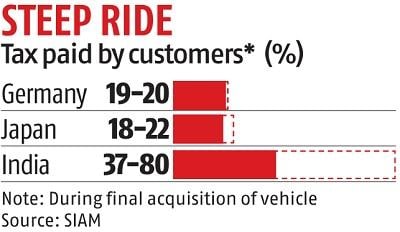
He pointed out that the sales of sport utility vehicles (SUVs) are rising when sales in other segments are not. “I am keen to understand the reason behind the fall in numbers after 2017-18 for a sector that promised high growth a few years back,” said Bajaj, adding that if taxes are reduced, it will force the government to borrow more. This can have a negative impact on the macroeconomy. “A 360-degree view must be taken before making a decision,” said Bajaj.
Bhargava retorted saying the growth of SUV as a metric is not the correct way since most buyers prefer entry-level models whose prices have gone up by Rs 45,000-50,000 due to the new safety and emission norms, rising insurance, and road tax.
“Those earning better have graduated to an SUV. But for a large section, like the buyer of an Alto or WagonR, an increase of Rs 45-50,000 is enormous. At the lower end, most can barely afford a car. Please keep the affordability factor in mind,” he cautioned.
This is the second time that a difference in opinion between the industry and the government has arisen. Last year, Shekar Viswanathan, former vice-chairman of Toyota Kirloskar Motor, had said the government keeps taxes on cars and motorbikes so high that his company finds it difficult to expand.
But the finance ministry countered saying auto companies should reduce royalty payments to parents abroad instead of seeking tax cuts.
 Dear Reader,
Business Standard has always strived hard to provide up-to-date information and commentary on developments that are of interest to you and have wider political and economic implications for the country and the world. Your encouragement and constant feedback on how to improve our offering have only made our resolve and commitment to these ideals stronger. Even during these difficult times arising out of Covid-19, we continue to remain committed to keeping you informed and updated with credible news, authoritative views and incisive commentary on topical issues of relevance.
We, however, have a request.
As we battle the economic impact of the pandemic, we need your support even more, so that we can continue to offer you more quality content. Our subscription model has seen an encouraging response from many of you, who have subscribed to our online content. More subscription to our online content can only help us achieve the goals of offering you even better and more relevant content. We believe in free, fair and credible journalism. Your support through more subscriptions can help us practise the journalism to which we are committed.
Support quality journalism and subscribe to Business Standard.
Digital Editor
R C Bhargava, Venu Srinivasan face off with govt on auto GST rate - Business Standard
Read More



No comments:
Post a Comment