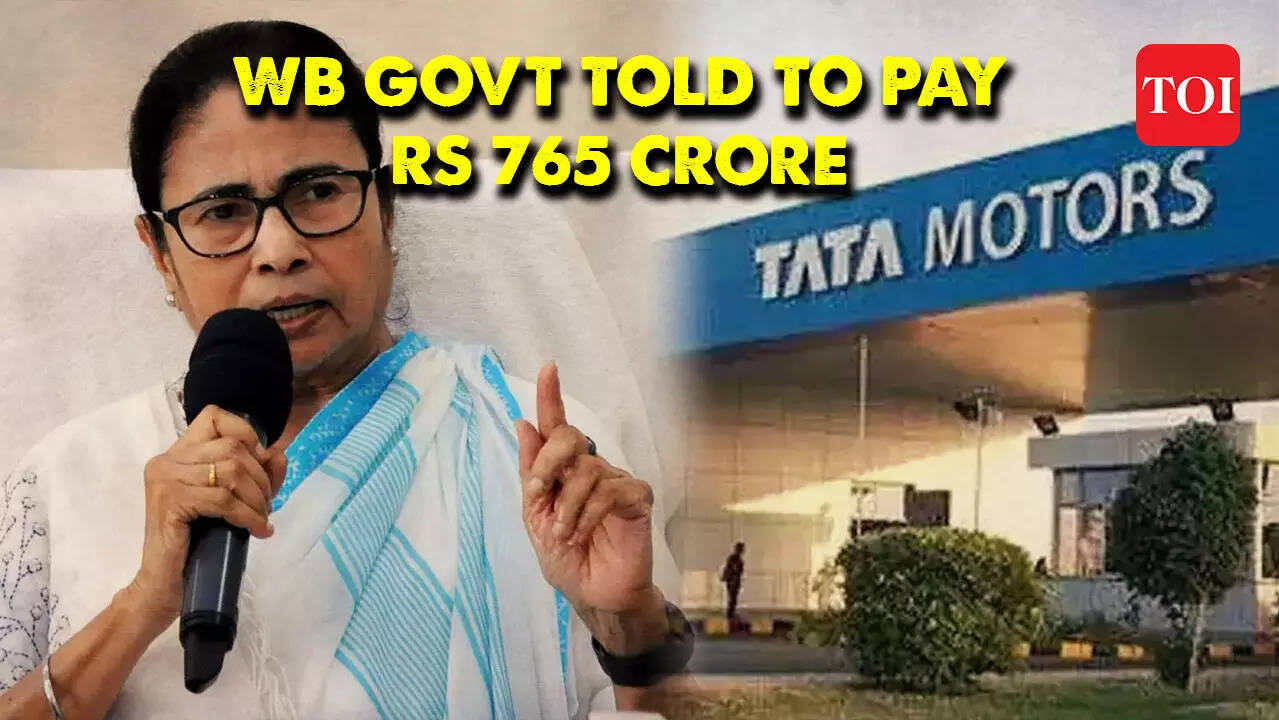
It’s a massive setback for Mamata Banerjee-led West Bengal government as a tribunal has asked it to pay Rs 765 crore compensation to Tata Motors for the latter’s investment in Singur. Tata Motors had to pull out due to stiff opposition by then opposition leader Mamata Banerjee. Tata Motors had to move out its planned Nano plant from Singur. Tata Motors says 3-member tribunal gave unanimous verdict in its favour.
Mumbai: AU Small Finance Bank Ltd on Sunday said it will take into its fold peer lender Fincare Small Finance Bank in the first such merger between two such institutions.
Under the amalgamation plan, shareholders of Fincare Small Finance Bank will get 579 equity shares of AU Small Finance Bank Ltd for every 2,000 fully paid-up equity shares they own.
Set up to push financial inclusion by providing an outlet for savings and by providing access to credit to small business units; small and marginal farmers; micro and small industries; and other unorganised sector entities, these banks were set up under an RBI policy from 2014. While AU Small Finance Bank started operations in April 2017, Disha Microfin (which later became Fincare SFB after a merger with Future Financial Services) commenced operations in July 2017.
“The scheme is subject to approval of the respective shareholders of the transferor company (Fincare Small Finance Bank Ltd) and transferee company (AU Small Finance Bank Ltd), the Reserve Bank of India (RBI) and the Competition Commission of India (CCI)," AU SFB said in a regulatory filing late on Sunday evening.
The statement said that the appointed date of the scheme shall be 1 February 2024, or a date as may be fixed mutually by both companies and approved by RBI.
As of 30 September, AU Small Finance Bank had total assets of ₹95,977 crore and a net worth of ₹11,763 crore, while Fincare Small Finance Bank had total assets of ₹14,777 crore and a net worth of ₹1,539 crore. While shares of AU SFB are listed on the stock exchanges, Fincare SFB’s plan for a share sale received a nod from the market regulator Securities and Exchange Board of India (Sebi) last month.
The statement said that the banks believe the consolidation is “founded on leveraging of the significant complementarities that exist between both the small finance banks, particularly relating to branch network, product offerings and customer segments".
“This revenue synergy-led and growth-oriented amalgamation, adopting best practices of banking, technology, governance and prudence from both banks, is expected to result in a superior platform benefitting from efficiencies of size and scope over time for all stakeholders such as customers, employees, and shareholders," it said.
As of 30 September promoters held 25.49% in AU Small Finance Bank, while in Fincare, promoters owned 78.58% as of 31 March.
"Exciting news! Mint is now on WhatsApp Channels 🚀 Subscribe today by clicking the link and stay updated with the latest financial insights!" Click here!
BENGALURU, Oct 30 (Reuters) - Blackstone (BX.N) said on Monday it will buy a majority stake in India's Care Hospitals from a fund belonging to asset management firm TPG, marking the U.S.-based private equity firm's entry into the country's healthcare services sector.
Blackstone will commit $1 billion in the hospital chain in India and hold over 75% in Care Hospitals, a source with direct knowledge of the matter said. They did not want to be named as the deal details are private.
The deal comes as a post-pandemic boom in demand for private healthcare in India has made the sector attractive, with global investors seeking an entry into healthcare chains in the country.
"Life sciences is a key investment theme for Blackstone and we plan to bring in our global scale and operating expertise," said Ganesh Mani, managing director at Blackstone Private Equity.
In a separate deal, Care Hospitals will buy a majority stake in KIMSHEALTH, which operates under Kims Healthcare Management, to form one of India's largest hospital platforms with 23 facilities and more than 4,000 beds across 11 Indian cities.
The value of both the deals is between $1.3 billion and $1.5 billion, the source added. The companies did not disclose financial terms of the deal.
TPG, which has a stake in Care Hospitals through its Evercare Health Fund, will retain a significant minority stake in the combined platform, the statement said.
Blackstone and Care did not immediately respond to Reuters' queries seeking financial details.
Hong Kong-based investment firm BPEA EQT, Baring Private Equity Asia, will acquire a 60% stake in Indian fertility services provider Indira IVF for 54 billion indian rupees ($648.63 million), Reuters had reported in July, citing a source.
($1 = 83.2525 Indian rupees)
Reporting by M. Sriram in Mumbai and Rama Venkat in Bengaluru; Editing by Nivedita Bhattacharjee
Sriram leads Reuters' deals coverage in India, including reporting and writing on private equity funds, IPOs, venture capital, corporate M&A and regulatory changes. His reportage includes scoops on large transactions as well as deeper analyses and insightful stories on the inner workings of companies, funds and industry trends that fly below the radar. He is a business journalist for five years by training, with a postgraduation from the Asian College of Journalism's Bloomberg program in financial journalism. He graduated from the course's inaugural batch. Contact: +919632913911
Bharat Sanchar Nigam Limited (BSNL) has started rolling out 4G in Punjab. The company has completed the beta testing with 200 sites and is now looking to complete the 4G rollout in Punjab by the coming December. The state-run telecom company aims to deploy 4G across the country by June 2024, after which the focus would shift to 5G rollout, confirmed Chairman and Managing Director (CMD) of BSNL, P.K. Purwar. As reported by PTI, Purwar said that BSNL is in the process of installing 3000 sites in Punjab.
The deployment will slowly be scaled to 6,000, and then 9,000, 12,000, and 15,000 sites per month. One of the big statements by Purwar during the IMC 2023 was that BSNL aims to complete its 4G rollout by June 2024. After that, the company wants to start rolling out 5G. At the IMC 2023, the radio gear that Tejas Networks is providing to BSNL was showcased. BSNL's entire 4G network will be homegrown. Even the telco's 5G will be homegrown as it will be released using the same equipment that Tejas Networks has provided to the company.
BSNL will be offering 4G in rural areas and places where high-speed broadband access is missing. This will enable India to reduce the digital divide that exists and also provide more people with opportunities that the digital world presents. BSNL's 4G is expected to be more affordable than what private telcos offer their 4G for.
BSNL's loss widened to Rs 8161.56 crore for FY23. However, the government expects the company to become profitable by FY27. The growth of the wireless network services business will be fueled by 4G and 5G in the coming years for BSNL. The state-run telecom company aims to be more affordable than its competitors.
Satellites have evolved from being a vanilla backhaul system to becoming a base station in the sky and the co-existence of satellite communications with other mobile technologies is now a reality, Reliance Jio President Mathew Oommen has said.
Speaking to the press on the sidelines of the seventh India Mobile Congress (IMC), he said Reliance Jio, moving beyond traditional terrestrial spectrum, had become a non-terrestrial network player and was way ahead of competition.
While satellites have historically been used for backhaul services, satellite spectrum has begun serving the same devices and customers as that of terrestrial spectrum over the past two years, Oommen pointed out.
Satellite spectrum, or orbit spectrum, is a segment of radio spectrum made available when satellites are placed into orbit. A debate over whether the scarce resource should be auctioned or allocated by the government has split the telecom industry.
As part of the Telecom Regulatory Authority of India’s (Trai’s) last consultation process in June, tech firms like Elon Musk’s Starlink, Amazon’s Project Kuiper, Telesat, Tata Group’s Nelco, and Hughes had been united in their opposition to the auctioning of satcom spectrum.
In contrast, telecom operators remained divided. Bharti Enterprises has pushed for allocation while Reliance Jio wants auction.
“If it (satellite spectrum) is the same type of service, going to the same devices and the same customers, and using the same standards, should there be a different spectrum policy? My answer is ‘no’,” Oommen said.
On the issue of there being no global precedent of a nation auctioning satellite spectrum, he said the United Arab Emirates had recently auctioned it while Thailand did so for orbital slots.
“We as a nation are the most spectrum-deprived, and just because somebody didn’t do something, that doesn’t mean it needs to be applicable for us. We need to do what is right for us. We are no longer a Tier-II nation and can’t have a regressive policy to be applied to a progressive technology,” he said. To questions on how Jio planned to provide affordable satcom services to remote areas, he said the vast sums in the government’s Universal Service Obligation (USO) fund should be given to telcos to be used for further investment.
“If we want to drive the Digital India vision, we should take that and put it to use,” he said.
The government imposes a universal access levy on telecom service providers of 5 per cent of their annual adjusted gross revenues. That goes to the Telecom Department’s USO fund, which had an unused surplus of Rs 75,689 crore as of June 30, 2023, the official data shows.
The fund should be leveraged for not just putting up towers but also giving subsidies to Indians who can’t afford the transition, Oommen said.
Satcom race hotting up
The Department of Telecommunications (DoT) has granted Eutelsat OneWeb and Reliance Jio’s satellite arm Jio Space the licence for Global Mobile Personal Communication by Satellite Services (GMPCS). The licence is needed to offer satellite-based broadband service in India.
Both companies are now facing off in the segment, with Jio successfully demonstrating at the IMC its Jio SpaceFiber service, India’s first satellite-based gigabit speed broadband service to previously inaccessible geographies in the country.
Meanwhile, Bharti Airtel Chairman Sunil Bharti Mittal said Bharti Airtel-backed Eutelsat OneWeb’s satellite communication service would be available in India from next month.
Oommen said the satellites of Luxembourg-based satellite telecommunications network provider SES, leveraged by JioSpaceFiber, would give the company an edge.
Eutelsat OneWeb, created last month through a merger between OneWeb and French satellite operator Eutelsat Communications, is banking on a combination of GEO-LEO fleet of satellites.
However, Oommen said unlike the hundreds of satellites needed by LEO systems to cover the earth, Jio would require eight-nine MEO satellites to cover the earth, he said.
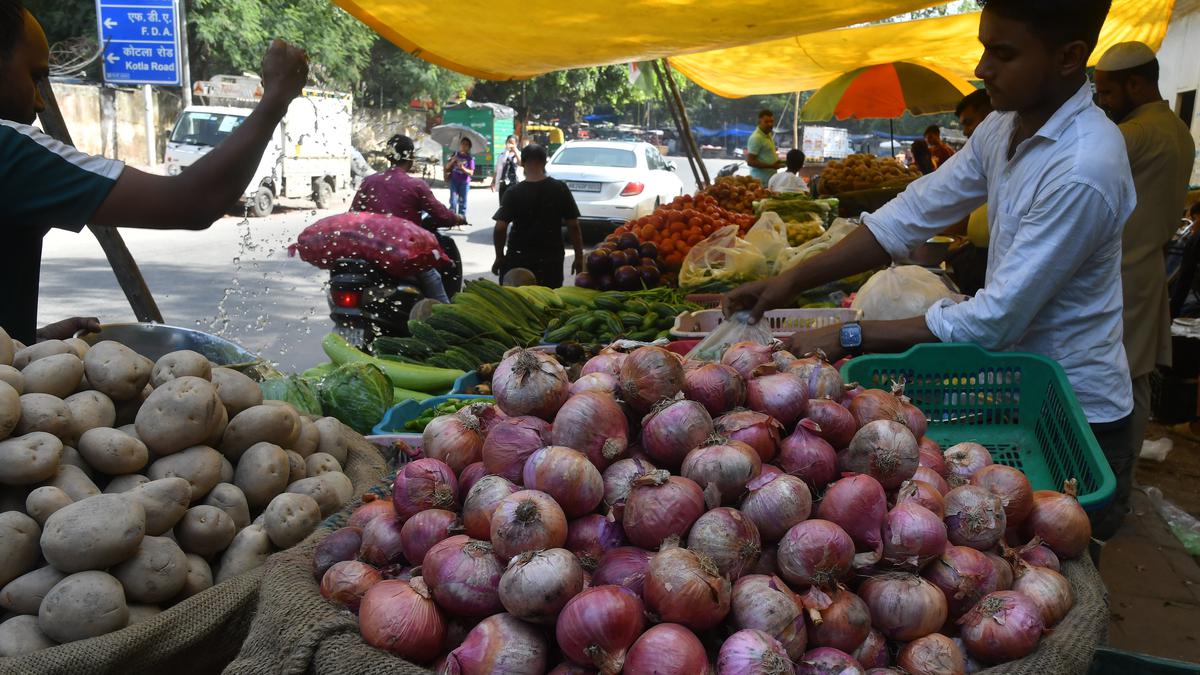
The government on Saturday imposed a minimum export price (MEP) of $800 per tonne on onion exports till December 31 this year with a view to increase availability of the vegetable in the domestic market and contain prices.
"Exports on onion is free. MEP of $800 FOB (free on board) per tonne is imposed till December 31, 2023," the Directorate General of Foreign Trade said in a notification.
Onion prices have further risen to ₹65-80 per kilogramme in the retail market of the national capital on lower supply.
Mother Dairy, which has around 400 Safal retail stores in the Delhi-NCR, is selling loose onions at ₹67 per kg. E-commerce portal Bigbasket is selling at ₹67 per kg, while Otipy at ₹70 per kg.
Domestic equity benchmarks Nifty 50 and Sensex plunged sharply lower in the past week and lost more than 2.5 per cent, the steepest such drop since the week ended September 22, mostly weighed by week global cues. The blue-chips bounced back by 1 per cent, in the final session on Friday, October 27, snapping a six-day losing streak, supported by some healthy corporate results and value-buying in auto, IT, financial and energy stocks.
On Friday, Nifty 50 closed 190 points, or 1.01 per cent, higher at 19,047.25 while the Sensex closed at 63,782.80, up 635 points, or 1.01 per cent. Mid and smallcaps outperformed the benchmarks. The BSE Midcap index rose 1.70 per cent while the Smallcap index ended with a gain of 1.89 per cent on October 27.
IT stocks, battered in the past two weeks by weak corporate earnings, gained 1.24 per cent after data showed inflation cooled in the United States, a key market for IT companies.
Sensex and Nifty have slipped 3.18 per cent and 3.17 per cent in the last seven days. This week, all sectoral indices ended in red with media and metal declining the most.
In the broader markets, the domestically focused small- and midcaps have lost 5.1 per cent and 6.4 per cent, respectively in the past six sessions. However, they are still up 30 per cent and 23 per cent, respectively, so far this year, well above the Nifty's 5.2 per cent increase.
In six trading sessions till October 26, Sensex had declined 3,279.94 points. The domestic market has been under pressure in October because of foreign capital outflow, unimpressive July-September quarter results, record-high US bond yields and Middle East tensions. Nifty 50 is down about 3 per cent this month so far.
US bond yields surged to 17-year high mark at 5 per cent as Federal Reserve Chairman Jerome Powell said earlier this month that more interest rate hikes may be required to bring inflation down to a 2 per cent target because of a tight labour market and resilient US economy. The 10-year US treasury yields rose 3 basis points (bps) to 4.845 per cent after scaling 5 per cent earlier in the week.
On the stock-specific front, 10 smallcap stocks logged gains in the range of 10 per cent - 25 per cent last week, outperforming the index. Bombay Bumrah, Black Box, Sadhana Nitro, Angel Broking, CreditAccess Grameen, Swan Energy, Ramco Industries, Voltamp Transformers, KDDL, and Styrenix Performance are among the smallcaps that logged a double-digit rise in their share prices last week.
Where are markets headed?
Market experts highlighted that the frontline indices ended a three-month long consolidation phase, with the tone being bearish for most of the week but some losses were trimmed in the final session. "The correction in small- and mid-caps over the last week is still puny compared to the rally over the past six to seven months," said analysts at Kotak Institutional Equities.
Analysts say that decent Q2 results in India, which were in line with optimistic estimates, may also support the market's rebound. ‘’However, the volatility of the global market is expected to delay the recovery trend of the domestic market, since the global market is focused on the risk of further slowdown of the global economy due to elevated interest rate and geo-political tension,'' said Vinod Nair, Head of Research at Geojit Financial Services.
Amidst the ongoing market consolidation, sectors such as FMCG, consumption, fertilizers, and core segments like infrastructure, housing, are expected to present potential growth opportunities.
‘’While US Fed’s rate decision on Wednesday will be a key event, investors would also await BOJ’s meeting outcome on Monday amid high global bond yield. We expect market to continue with its volatile move going forward ahead of key economic events and ongoing earning season,'' said Siddhartha Khemka, Head - Retail Research, Motilal Oswal Financial Services.
"Exciting news! Mint is now on WhatsApp Channels 🚀 Subscribe today by clicking the link and stay updated with the latest financial insights!" Click here!





COMMents