Rechercher dans ce blog

Tuesday, March 1, 2022

Russia-Ukraine war to delay LIC IPO launch? FM Nirmala Sitharaman makes big statement - India Today

The central government is likely to review the timing of launching the initial public offering (IPO) of LIC amid the ongoing war between Russia and Ukraine, Finance Minister Nirmala Sitharaman has said.

In an interview with the Hindu BusinessLine, FM Sitharaman said, "When I last commented on this matter, the tension was building up. Now there’s a full-scale war. Therefore, I need to go back and review the situation."

She said 'ideally' the government would like to go ahead with the much awaited mega IPO. However, if global circumstances demand, the FM said she won't hesitate to look into it again.

RUSSIA-UKRAINE CONFLICT IMPACT

The conflict in eastern Europe has impacted global stock markets, including the BSE Sensex and NSE Nifty, and international oil prices. Several experts have cautioned that global inflation level may go up due to Russia's invasion of Ukraine.

STAGE SET FOR MARKET LAUNCH

Last week, the Union Cabinet chaired by Prime Minister Narendra Modi permitted up to 20 per cent foreign direct investment (FDI) under automatic route in IPO-bound LIC with the aim of facilitating disinvestment of the country's largest insurer.

Setting the stage for the country's biggest-ever public offering, Life Insurance Corporation on February 13 filed draft papers with capital market regulator Sebi for the sale of 5 per cent stake by the government for an estimated Rs 63,000 crore.

LIC IPO DETAILS

The initial public offering (IPO) of over 31.6 crore shares or 5 per cent government stake is likely to hit D-street in March. Employees and policyholders of the insurance behemoth would get a discount over the floor price.

According to the draft red herring prospectus (DRHP), LIC's embedded value, which is a measure of the consolidated shareholders value in an insurance company, has been pegged at about Rs 5.4 lakh crore as of September 30, 2021, by international actuarial firm Milliman Advisors.

Although the DRHP does not disclose the market valuation of LIC, as per industry standards, it would be about three times the embedded value or around Rs 16 lakh crore.

BIGGEST IPO IN INDIA

The LIC public issue would be the biggest IPO in the history of the Indian stock market. Once listed, LIC's market valuation would be comparable to top companies like RIL and TCS.

So far, the amount mobilised from the IPO of Paytm in 2021 was the largest ever at Rs 18,300 crore, followed by Coal India (2010) at nearly Rs 15,500 crore and Reliance Power (2008) at Rs 11,700 crore.

ALSO READ | LIC IPO: Two must do things for policyholders

Adblock test (Why?)


Russia-Ukraine war to delay LIC IPO launch? FM Nirmala Sitharaman makes big statement - India Today
Read More

Ashneer Grover resigned after receiving Board meet agenda on PwC probe - Business Standard

Ashneer Grover, the embattled co-founder of financial technology (fintech) unicorn BharatPe, resigned as managing director (MD) and company’s board director on Monday. The company later said Grover’s resignation letter was received within minutes after a board meeting was called to deliberate on an audit report by accounting firm PwC.

“Grover resigned as MD and board director of BharatPe, minutes after receiving the agenda for the upcoming board meeting that included submission of the PwC report regarding his conduct and considering the actions based on it. The board reserves the right to take action, based on the report’s findings,” the company said.

A source close to the development said Grover currently has 9.5 per cent shareholding in the company. However, the board meeting, which started late Tuesday evening (as some directors are in the US), is expected to discuss the PwC forensic audit report, consider his resignation letter, and might also touch upon the possibility of clawing back his shares in accordance with the articles of association and shareholding agreement. However, the full review on governance and risk management is still ongoing. The board meeting, however, had not ended till the time of going to press.

chart

“The agenda of the meeting was sent at 11.56 pm on Monday. What was the urgency to send the agenda at midnight? I have written my resignation over two days,” Grover told Business Standard.

ALSO READ: The unravelling of Ashneer Grover's fortunes: A blow-by-blow account

“They can’t do anything with the shares since the shareholder agreement (SHA) does not allow them at all (to claw back shares),” he added.

Grover’s resignation has come days after a plea filed by him with the Singapore International Arbitration Centre was dismissed. In his petition, the co-founder had sought indemnity from the audit report and asked to render it invalid as it did not comply with the SHA.

Last month, had appointed risk advisory firm Alvarez & Marsal and Big Four accounting firm PwC to probe alleged financial irregularities on Grover and his wife Madhuri Jain’s watch. Jain, who was head of controls at BharatPe, was fired by the unicorn last week.


ALSO READ: Investor-founder relation in India is one of master-slave: Ashneer Grover

‘Master-slave’ relationship

In his resignation letter to the board, Grover has hit out at investors and board members of the company for allegedly vilifying his family and him.

Shedding light on his fraught relationship with the company’s investors, he wrote: “You treat us founders as slaves — pushing us to build multi-billion-dollar businesses and cutting us down at will. Investor-founder relations in India is one of master-slave. I am the rebel slave who must be hung by the tree, so none of the other slaves can dare to be like me ever again.”

“None of you, including the ones based in India, have ever been to our office even once since the pandemic turned our lives upside down and sought to suffocate the economy. Not even once. Not Micky. Not Harshjit. Not Mohit. Not Teru San. Not Rahul. Not Deven. No one. None of you even turned-up despite an invitation for the inauguration of our new office,” he added.

Grover was referring to Meyer ‘Micky’ Malka of Ribbit Capital, Harshjit Sethi of Sequoia Capital, Teruhide Sato of Beenext, Rahul Vijay Kishore of Coatue Management, and Deven Parekh of Insight Partners.

Ribbit Capital owns 11 per cent of shareholding in the company, Beenext holds 9.6 per cent, Sequoia Capital 19.6 per cent, and Coatue Management 12.4 per cent, according to the data from Tracxn. Insight Partners holds around 10 per cent of the company, according to media reports.

Dear Reader,

Business Standard has always strived hard to provide up-to-date information and commentary on developments that are of interest to you and have wider political and economic implications for the country and the world. Your encouragement and constant feedback on how to improve our offering have only made our resolve and commitment to these ideals stronger. Even during these difficult times arising out of Covid-19, we continue to remain committed to keeping you informed and updated with credible news, authoritative views and incisive commentary on topical issues of relevance.
We, however, have a request.

As we battle the economic impact of the pandemic, we need your support even more, so that we can continue to offer you more quality content. Our subscription model has seen an encouraging response from many of you, who have subscribed to our online content. More subscription to our online content can only help us achieve the goals of offering you even better and more relevant content. We believe in free, fair and credible journalism. Your support through more subscriptions can help us practise the journalism to which we are committed.

Support quality journalism and subscribe to Business Standard.

Digital Editor

Adblock test (Why?)


Ashneer Grover resigned after receiving Board meet agenda on PwC probe - Business Standard
Read More

Ukraine war may delay LIC IPO to next FY, likely reassessment of March listing this week - Moneycontrol

The much-awaited initial public offering of state-run insurance giant Life Insurance Corporation of India (LIC) could be pushed to the next financial year, as the government is likely to hold a meeting to reassess the IPO timing in view of the escalating Russia-Ukraine war, sources told CNBC TV18 on March 1.

The meeting for a likely reassessment of LIC listing will be held "this week", a government official privy to the development told the news channel.

Finance Minister Nirmala Sitharaman has "stated the government position" on the matter, the official said, referring to her remarks during a recent interview with Hindu Business Line, where she suggested that the emerging global situation may warrant a relook at the IPO timing.

“Ideally, I’d like to go ahead with it because we had planned it for some time based purely on Indian considerations," Sitharaman told the newspaper, adding that "if global considerations warrant that I need to look at it, I wouldn’t mind looking at it again".

The draft red-herring prospectus for the LIC IPO was released on February 13. The offer is for the sale of up to 316.25 million shares or around 5 percent held in the insurance sector behemoth by the Centre.

Sitharaman, while addressing reporters in Mumbai on February 22, had said the government was going ahead with the IPO which has generated a positive buzz in the market.

"There is a buzz in the market and there is interest for LIC IPO. We are going ahead with it," Sitharaman had said, but also noted that "we are equally worried if the market situation is conducive".

Notably, the military conflict in eastern Europe has sent jitters to markets around the world. The sanctions imposed on Russia are feared to exacerbate the crisis, with the commodities market first to be adversely hit. Crude oil prices have crossed $100, and Goldman Sachs has raised its one-month Brent forecast to $115.

The sanctions have hammered the Russian market. The geopolitical tensions also affected bourses in Europe, where the primary German and French exchanges plummeted by over 3 percent in the early trading hours of this week.

Adblock test (Why?)


Ukraine war may delay LIC IPO to next FY, likely reassessment of March listing this week - Moneycontrol
Read More

Ukraine war may delay LIC IPO to next FY, likely reassessment of March listing this week - Moneycontrol

The much-awaited initial public offering of state-run insurance giant Life Insurance Corporation of India (LIC) could be pushed to the next financial year, as the government is likely to hold a meeting to reassess the IPO timing in view of the escalating Russia-Ukraine war, sources told CNBC TV18 on March 1.

The meeting for a likely reassessment of LIC listing will be held "this week", a government official privy to the development told the news channel.

Finance Minister Nirmala Sitharaman has "stated the government position" on the matter, the official said, referring to her remarks during a recent interview with Hindu Business Line, where she suggested that the emerging global situation may warrant a relook at the IPO timing.

“Ideally, I’d like to go ahead with it because we had planned it for some time based purely on Indian considerations," Sitharaman told the newspaper, adding that "if global considerations warrant that I need to look at it, I wouldn’t mind looking at it again".

The draft red-herring prospectus for the LIC IPO was released on February 13. The offer is for the sale of up to 316.25 million shares or around 5 percent held in the insurance sector behemoth by the Centre.

Sitharaman, while addressing reporters in Mumbai on February 22, had said the government was going ahead with the IPO which has generated a positive buzz in the market.

"There is a buzz in the market and there is interest for LIC IPO. We are going ahead with it," Sitharaman had said, but also noted that "we are equally worried if the market situation is conducive".

Notably, the military conflict in eastern Europe has sent jitters to markets around the world. The sanctions imposed on Russia are feared to exacerbate the crisis, with the commodities market first to be adversely hit. Crude oil prices have crossed $100, and Goldman Sachs has raised its one-month Brent forecast to $115.

The sanctions have hammered the Russian market. The geopolitical tensions also affected bourses in Europe, where the primary German and French exchanges plummeted by over 3 percent in the early trading hours of this week.

Adblock test (Why?)


Ukraine war may delay LIC IPO to next FY, likely reassessment of March listing this week - Moneycontrol
Read More

Kitchen staples like milk, chicken, oils, wheat and spices become expensive due to Russia-Ukraine war - Economic Times

The demand surge uncorked as covid cases ebbed coupled with supply shortages in domestic production and imports due to the Russia-Ukraine war have increased inflation worries. Consumers will have to brace for unprecedented rise in prices of animal protein including poultry, dairy products, and seafood. Dairy industry leader Amul has increased retail milk prices by 4% starting March 1 in all India markets.

The war has directly affected the prices of sunflower oil, while prices of wheat, coriander, jeera, maize and soyameal due to the indirect effect of drying up of supplies of these commodities from Russia and Ukraine.

Rohit Ahuja, head, research, at ratings agency ICRA said, “At the initial stage, we believe the implications on India would be restricted to rise in commodity prices. However, there are risks from escalation of this conflict to other parts of Europe, and a further surge in commodity prices”


"This price rise is being done due to rising costs of energy, packaging, logistics, and cattle feeding costs. Thus the overall cost of operation and production of milk has increased," said Amul in a release.

Prices of milk and milk products are heading northwards globally as in India since the past 4 to 5 months. There is global shortage of milk protein as cattle was culled due to covid induced demand destruction, while in India, where culling of cows is not allowed, the production cycle has prolonged.

Dashrath Mane, chairman, Sonai Dairy, the contract manufacturer for the country’s top retail brands and second largest exporter of milk powder after Amul, said "There is huge export demand for milk powder and the returns have almost doubled."

In a recent research note on dairy sector, Crisil had said “Revenue of India’s organised dairy industry will rebound a solid 12% on-year this fiscal to Rs 1.6 lakh crore, compared with a decadal low growth of ~1% last fiscal, riding on strong demand recovery in most value-added dairy products, steady liquid milk sales, and retail price hikes during the fiscal.”

The Russia-Ukraine conflict has dimmed any hopes of respite from high cooking oil prices for the consumers, who have been paying historically high prices for close to two years.

Chicken prices have jumped 25% since January and industry veterans expect a further increase of 10% to 50% in different parts of the country in March due to acute shortage of feed.

Balram Yadav, managing director, Godrej Agrovet said, "Our chick production has reduced by 20% due to demand disruption caused by the pandemic in contact-based industries. Post Covid, we expect a huge demand surge."

BV Mehta, executive secretary, the Solvent Extractors' Association said, "Of the 2.5 million tonne sunflower oil consumed in India, about 90% is imported from Ukraine and Russia. Opening the Rupee Ruble channel can ease these imports. The silver lining is that India has a big stock of uncrushed soyabean and a record harvest of mustard is ahead."

The prices of sunflower oil in the international market have increased by about 5% to 10% in 8-10 days.

"Due to sanctions on Russia, it is now difficult to open Letter of Credit (LC) to import sunflower oil. We have requested the government to explore the possibility of getting exclusion for sunflower oil from sanctions like the European countries have for oil and gas," said Sandip Bajoria, CEO, Sunvin Group, a consulting company.

Spices prices are also on the boil due to local shortages and strong global demand. "Coriander prices have increased by about 30% during the past few months as the crop is smaller. Now, we expect increased export demand for Indian coriander as supplies from the black sea region will be restricted," said Ashwin Nayak, founding chairman, Federation of Indian Spice Stakeholders.

Jeera prices have jumped 25-30% in four months due to reduced production and global demand. India is now the only prominent jeera supplier as supplies from countries like Afghanistan, Turkey and Syria have been disturbed due to geopolitical reasons.

Like coriander, wheat prices in India are likely to move upwards due to the indirect effect of the war. Most of the wheat stock in India is held by government agency Food Corporation of India (FCI), which is not exporting the commodity. However, the demand for Indian wheat in the international market has increased since the outbreak of the war.

"The prices of wheat at the Kandla port have increased from Rs 2200/quintal to Rs 2350-2400/quintal in the last 4 days. With FCI declaring that its upcoming tender this week will be the last one in March, we think that the prices of wheat and wheat products may increase during the next 10-15 days. The next crop will be harvested only after Baisakhi, which falls on April 13," said Sanjay Puri, past president, The Roller Flour Millers Association of India.

Adblock test (Why?)


Kitchen staples like milk, chicken, oils, wheat and spices become expensive due to Russia-Ukraine war - Economic Times
Read More

Stocks slide on Ukraine woes, oil storms back above $100 By Reuters - Investing.com

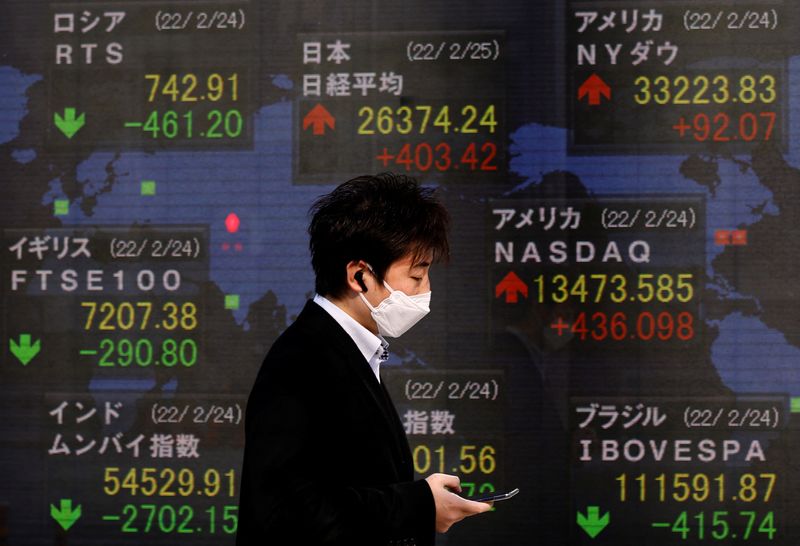
2/2 Stocks slide on Ukraine woes, oil storms back above $100 © Reuters. FILE PHOTO: A man wearing a protective mask, amid the coronavirus disease (COVID-19) outbreak, walks past an electronic board displaying Russian Trading System (RTS) Index, Japan's Nikkei index and the Dow Jones Industrial Average outside a brokerage in T 2/2

By Marc Jones

LONDON (Reuters) - European stocks tumbled, oil shot back above $100 a barrel and there was a stampede for U.S. and German government bonds on Tuesday as markets struggled with massive uncertainty caused by Russia's invasion of Ukraine.

Russia's equity markets remained suspended and some bond trading platforms were no longer showing prices, but dealing in the major financial centres both in Europe and in Asia overnight was orderly, albeit jittery.

Losses for the pan-European mounted again, with the index down nearly 2% by midsession () and Wall Street was expected to open between 0.5% and 1% lower. [.N]

There had initially been gains for mining and oil & gas stocks in Europe but even those had soured and a heavy 4% slump in bank stocks showed investors were now sensing that interest rate hikes might now get delayed or at least scaled down. ()

That sense saw the yields on U.S. 10-year Treasuries, which are a key driver of global borrowing costs, fall sharply to five-week lows. Staggeringly, the equivalent 10-year German Bund yield was heading for its biggest one day fall since 2011. [GVD/EUR]

Paul Jackson, global head of Asset Allocation Research, Invesco said: "assuming no rapid resolution to this conflict, we fear that global GDP could be reduced by 0.5%-1.0%."

"That's enough to aggravate the ongoing slowdown but not enough to produce recession," although he cautioned that some parts of Europe could see a recession and that inflation was also likely to stay higher for longer.

High-level talks between Kyiv and Moscow on Monday had ended with no agreement except to keep talking, and nerves were acute as a huge Russian armoured column bore down on Kyiv on Tuesday after lethal shelling of civilian areas in Ukraine's second largest city Kharkiv.

With Russia one of the world's largest oil and producers, futures tore up $5.15, or 5.3%, to $103.12 a barrel. That was just below a seven-year high of $105.79 hit after Moscow launched its assault on Ukraine last week. [O/R]

European prices leapt nearly 15% too. Both oil and gas prices are now up nearly 60% since fears of an invasion of Ukraine began to escalate in November.

"The fragile situation in Ukraine and financial and energy sanctions against Russia will keep the energy crisis stoked and oil well above $100 per barrel in the near-term and even higher if the conflict escalates further," Louise Dickson, senior oil market analyst from Rystad Energy, wrote in a note.

ROUBLE

Concerns the war and higher energy prices could slow the global economy mean investors are now questioning how far and fast the likes of the U.S. Federal Reserve are likely to hike interest rates in the coming months.

Benchmark 10-year U.S. Treasury yields were down near 1.7% as U.S. trading gathered momentum having been over 2% less than two weeks ago [GVD/EUR], while those German Bunds were back in negative territory and the euro was down 0.5% as bets on an ECB hike this year withered. [FRX/]

February PMI Data had shown momentum in euro zone manufacturing growth had already waned slightly last month, although it was still relatively strong and firms said supply chain constraints had eased.

"It seems that the markets have started to reassess the monetary policy outlook," said Jan von Gerich, chief strategist at Nordea.

Russia's rouble appeared to be stabilising somewhat after plunging as much as 30% to a record 120 per dollar after Western countries had slapped Russia with the most far-reaching sanctions ever placed on such an interconnected global economy.

Those measures include cutting Russia's top banks from the SWIFT international financial network and sanctioning its central bank in a bid to limit Moscow's ability to deploy its $630 billion of foreign reserves.

Russia responded on Tuesday by temporarily stopping foreign investors from selling Russian assets to ensure they take a "considered decision" Prime Minister Mikhail Mishustin said. Russia's huge sovereign wealth fund will also be pressed into action, spending up to 1 trillion roubles ($10.3 billion) to buy shares in Russian companies, a source close to the government told Reuters.

Sanctions though mean that the big global banks are now reluctant to trade with Russian banks and vice versa, which means there are now effectively two different rouble currency markets - one in Russia and one internationally.

Traders in London were quoting the rouble at between 101 and 105 per dollar, although it had been around 94 per dollar according to some local market prices.

More broadly, currency market volatility is at its highest since late 2020, as measured by a Deutsche Bank (DE:) index and the rouble is down almost 30% from its best levels this year.

"Today, the focus will be on whether sanctions/retaliation will start impacting the commodity flows from Russia, and whether (Russia's central bank) will step in with more measures to support the rouble," ING FX analysts wrote in a note to clients.

Trading in Russian stocks remains suspended on the Moscow Exchange and Russian sovereign and corporate bond prices were not showing on some trading platforms. JPMorgan (NYSE:)'s widely tracked GBI-EM Global Diversified index did still include Russia's rouble-denominated bonds although Monday's market plunge had slashed their so-called weighting in the index.

Foreign investors held $20 billion of Russia’s dollar- and rouble-denominated government debt at the end of last year according to Russian central bank data while they own just over $85 billion worth of equities according to the Moscow Exchange.

"A lot of the (global) price action is a function of uncertainty." said Madison Faller at JPmorgan Private Bank.

(Additional Reporting by Sujata Rao in London; Editing by Chizu Nomiyama and Bernadette Baum)

Adblock test (Why?)


Stocks slide on Ukraine woes, oil storms back above $100 By Reuters - Investing.com
Read More

Monday, February 28, 2022

BharatPe Co-Founder Ashneer Grover Quits Firm, Days After Wife Was Sacked - NDTV Profit

BharatPe Co-Founder Ashneer Grover Quits Firm, Days After Wife Was Sacked

This comes days after BharatPe sacked Ashneer Griver's wife Madhuri Jain Grover.

New Delhi: BharatPe Co-Founder Ashneer Grover has resigned from the company and its board, Economic Times reported on Tuesday. This comes days after BharatPe sacked his wife Madhuri Jain Grover for alleged financial irregularities ranging from producing fake invoices to billing the company for personal beauty treatment and trips abroad.

In a letter addressed to the BharatPe board, Mr Grover said, "I write this with a heavy heart as today I am being forced to bid adieu to a company of which I am a founder. I say with my head held high that today this company stands as a leader in the fintech world. Since the beginning of 2022, unfortunately, I've been embroiled in baseless and targeted attacks on me and my family by a few individuals who are ready not only to harm me and my reputation but also harm the reputation of the company, which ostensibly they are trying to protect."

He also stated that "from being celebrated as the face of Indian entrepreneurship he is now wasting his time fighting a long, lonely battle against his own investors and management. Unfortunately, in this battle, the management has lost what is actually at stake – BharatPe."

Mr Grover was sent on leave following allegations of using abusive language against Kotak Mahindra Bank staff and fraudulent practices, which he has denied.

He and his wife had accused the bank of reneging on a promise to get him shares worth Rs 500 crore when Nykaa's initial public offering (IPO) was launched.

Mr Grover had filed an arbitration plea with the Singapore International Arbitration Centre (SIAC) claiming the company's investigation against him was illegal. The SIAC, though, rejected his plea, giving him no relief in the matter.

Adblock test (Why?)


BharatPe Co-Founder Ashneer Grover Quits Firm, Days After Wife Was Sacked - NDTV Profit
Read More

Govt’s fiscal consolidation plan to aid private sector, boost capex revival - Moneycontrol

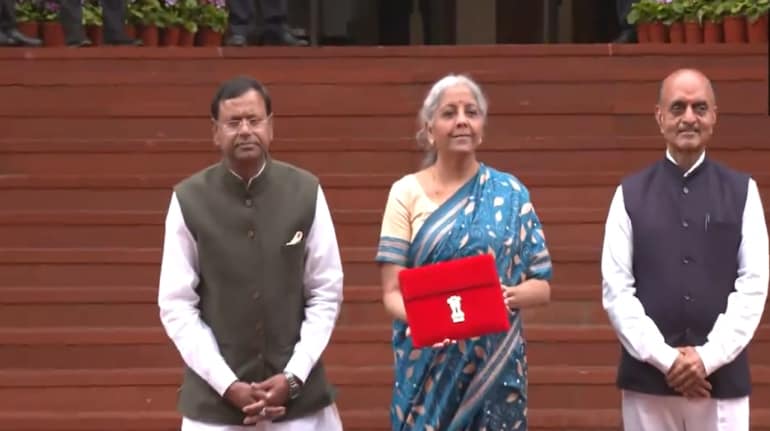
Finance Minister Nirmala Sitharaman The 2024 Interim budget is based on the robust framework of “Viksit Bharat by 2047.” Driving this gr...